Gas vs. Battery Outdoor Power Equipment
Battery or gas-powered equipment? How much does weight matter? Is the power there when you need it? How do you keep your crew productive throughout the workday? And does investing in a mobile charging infrastructure make sense for your operation?
At the same time, professionals are facing growing challenges, including rising fuel costs, noise restrictions, emissions requirements, and the need to work in noise-sensitive or environmentally sensitive areas. As a result, choosing the right power system is more important than ever.
This guide will help you determine when STIHL battery-powered equipment may be the right fit for your business and explore the benefits that advanced lithium-ion batteries can offer.


- The quick check: Which energy source will help you move forward?
- Quiet outdoor maintenance – a solution for landscaping companies and municipalities
- Powerful performance with proven backup – a solution for forestry
- Step by step: how to plan your switch
- Frequently asked questions about STIHL energy sources for pros
Gas or Battery-Power: Choosing the Right Power Solution for the Job
Battery and gas-powered tools each play an important role. The right choice depends on your application, working conditions, and the battery system that best meets your performance needs.
Battery-powered solutions are an excellent fit when work schedules are predictable and charging can be managed at your shop, in your vehicles, or at the job site. In return, you'll benefit from quieter operation, reduced vibration, zero exhaust emissions during use, and lower maintenance requirements.
Gas-powered equipment remains a strong choice when maximum runtime and independence from charging infrastructure are essential. For demanding, continuous-use applications, particularly in forestry, gas-powered tools continue to provide the extended runtime and flexibility many professionals rely on.
Designed for professional users, STIHL ALLPRO battery system offers a range of performance advantages over traditional gas-powered equipment. The comparison below highlights some of the key differences between STIHL battery-powered and gas-powered tools.
| Criteria | STIHL battery power tools with the ALLPRO battery system | STIHL gas power tool |
|---|---|---|
| Performance | Up to 60 percent more peak power than previous STIHL pro batteries4. | Constantly high performance even under extreme continuous load. |
| Runtime | Reliable runtime planning taking into account the number of batteries, capacity and charging infrastructure – with replacement batteries, quick chargers and mobile charging solutions. | Maximum independence for very long work assignments without charging breaks. |
| Maintenance | Minimal effort - no spark plugs or fuel filters required. | Increased maintenance effort due to regular maintenance of the gas systems. |
| Operating costs | Higher initial costs, but low running costs due to cheap electricity and less maintenance. | Lower initial costs, but running costs for gas and service. |
| Emissions and health impact | Exhaust-free, low-vibration and quiet – ideal for noise-sensitive areas such as schools or hospitals. | Emissions, stronger vibration and higher operating noise. Hearing protection is usually mandatory. |
| Use in the rain | Full operational safety in rain and wet conditions thanks to IPX4 or IPX5 certification3. | Fully weatherproof and robust for outdoor use. |
| Logistics | Charging planning and infrastructure required in the company or vehicle. | Logistics required for mixing, transporting and storing fuel. |
| Power tool weight | 5.8 lb power tool weight without battery on the example model MSA 190 T battery chainsaw. | 7.3 lb power tool weight (without fuel) on the example model MS 194 T gasoline chainsaw. |

The STIHL ALLPRO Battery System
The new STIHL ALLPRO system simplifies battery management by providing a single battery platform across your fleet. More than 60+ STIHL AP System tools use the same battery platform, while existing AP batteries and chargers integrate seamlessly thanks to full system compatibility.
Quiet outdoor maintenance - a solution for landscaping companies and municipalities

In landscaping, grounds maintenance, and municipal green space management, your crew needs equipment that delivers reliable performance in changing weather conditions. STIHL battery power tools are built to perform in rain and wet conditions while providing quieter operation and zero exhaust emissions during use. This makes them an ideal choice for residential neighborhoods, parks, schools, hospitals, cemeteries, and other noise-sensitive environments.
Featured Products


Powerful Performance. Proven Reliability. Built for WORK.

Battery or gas chainsaw? For extreme continuous loads or remote locations without a direct charging option, the combination of modern battery technology and gas power tools as a backup is a sensible strategy: this ensures productivity even in difficult off-road conditions. With up to 60 percent more peak power4 than previous battery solutions, the ALLPRO Battery System from STIHL delivers the necessary performance for demanding felling and pruning in small- and medium-sized trees.
Featured Products


Step by step: how to plan your switch TO BATTERY
Switching from gas-powered to battery-powered equipment is a manageable process when approached strategically. By assessing your equipment inventory, usage patterns, and charging capabilities, you can plan and execute the transition with confidence.
Track your current inventory of gas-powered tools and check how often you use them. This allows you to quickly identify where switching to a battery will provide the greatest relief in your daily work.
Determine how intensively and how long your teams work per day. Also consider noise-sensitive zones or working indoors - this is where battery solutions show their strengths in particular.
Determine the required power or energy capacity based on your type of work. Your nearest STIHL dealer will help you determine the right number of batteries for a smooth workflow without charging breaks.
Create the basis for an efficient energy supply. For mobile use, special trailer systems offer a weatherproof and safe charging infrastructure directly on site.
Request a demo of STIHL battery technology with local STIHL Commercial Solutions Specialist. Keep your gas-powered tools as a backup initially - this gives you extra peace of mind during the transition period. Read more on switching from gas-to-battery.
COnfidence Backed by STIHL Expertise and Guidance
Every equipment investment and operational change deserves careful planning. Take advantage of STIHL's proven expertise, support, and consultation services to help you make informed decisions with confidence.

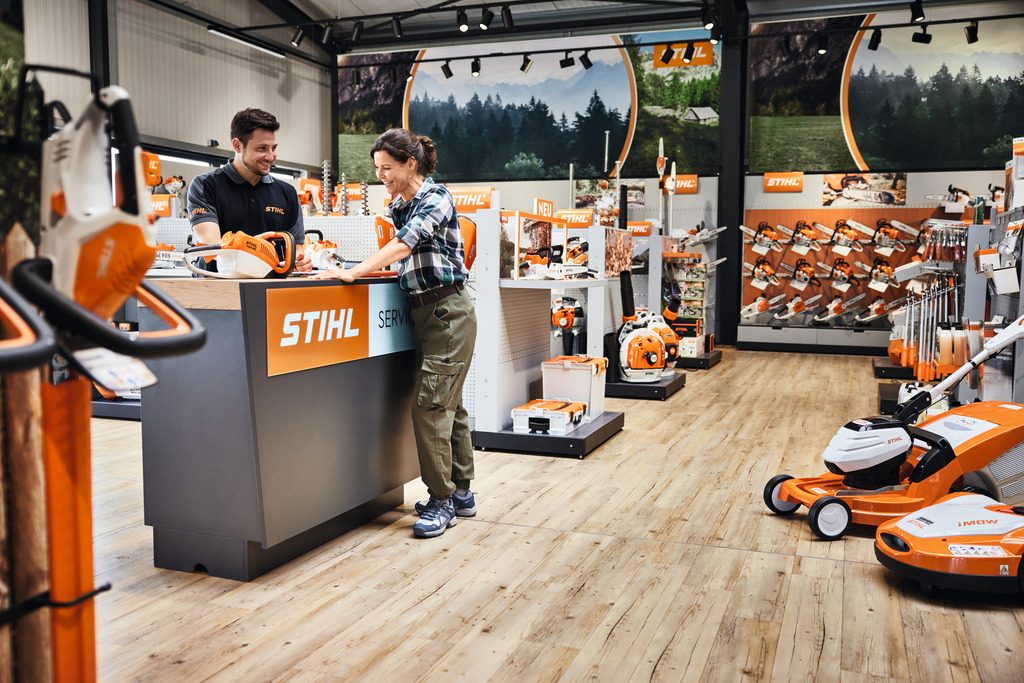
Real-life examples from everyday work


Frequently asked questions about STIHL energy sources for pros
Yes, the STIHL ALLPRO battery power system has been specifically developed for the most demanding professional requirements. With up to 60 percent more peak power compared to previous models, the performance is in no way lower than that of modern gasoline-powered tools. The STIHL MSA 300 is the first battery chainsaw on the market to offer full power for forestry. You can also benefit from high torque in clearing saws, which handle even dense shrubs effortlessly.
The ideal number of batteries depends on your individual deployment planning. Thanks to the high energy density and extremely short charge times, you don't have to keep a separate battery pack for each power tool. In practice, a two-person landscaping team has found that having three batteries and a high-speed charger works well. While two batteries are in use in the power tools, the third on the AL 1602 MO high-speed charger charges to 80 percent capacity in just 10 minutes1.
1 Charging time to 80% at ambient or pack temperatures of 70°F-104°F when used with the AL 1602 MO.
Although the initial cost is higher, the operating costs are significantly lower over the entire service life. You save on every hour of runtime, as the cost of fuel is completely eliminated. In addition, maintenance costs are significantly reduced as there is no need to service spark plugs, carburetors or fuel filters.
STIHL batteries are designed for heavy-duty use and, as part of the ALLPRO battery system, can withstand up to 3,000 charge cycles while maintaining consistent performance. Intelligent charging management supports reliable operation even under high loads. This means that the battery service life in professional use is designed for many years of daily use. This increases your planning security and enables you to work economically in the long term.
A modular switchover is highly recommended and can be designed flexibly. It is best to start in noise-sensitive zones or for specific applications such as hedge care. As all power tools in the respective battery system use the same battery type, you can easily expand your battery inventory as needed.
The robustness of the technology and mobile charging solutions ensure use availability even in remote locations. For example, all ALLPRO batteries have an IPX5 certification and are therefore water spray-proof – ideal for working in rainy conditions. Should problems arise, a STIHL dealer with professional maintenance service and loaner power tools options will keep you are up and running.
More about STIHL battery solutions


1 Charge cycles: Up to 3,000 cycles without noticeable loss of performance; still usable beyond that. Only valid for ALLPRO batteries AP 100.0 P, AP 200.0 P and AP 300.0 P (C)
2 Charging time to 80% at ambient or pack temperatures of 70°F-104°F when used with the AL 1602 MO.
3 IPX5 protection only applies to ALLPRO batteries AP 100.0 P, AP 200.0 P and AP 300.0 P (C). The ALLPRO AP 20.1 and AP 30.1 batteries are IPX4 certified.
4 Comparison with AP 300.0 P (C) and AP 300 S.